
Watch Battery Replacement Cost: A UK Price Guide
So what does it cost to replace a watch battery? More importantly, why does the price vary so drastically from shop to shop? The truth is, a high-street fashion watch and a heavy-duty diver's timepiece require completely different levels of work to open, replace, and reseal safely. That technical gap is exactly what dictates the final bill.
As watchmakers at AMJ Watch Repair in Hatton Garden, we believe in complete transparency. This guide outlines the honest figures, breaks down exactly what you are paying for, and explains how a cheap £5 battery swap can easily end up costing you hundreds in hidden damage.
Key Takeaways
A standard quartz watch battery replacement in the UK typically costs £10–£40. You aren't just paying for the battery; you’re paying for the expertise to open and handle your watch safely.
Replacing the battery in a water-resistant watch costs between £40 and £150+. This covers brand-new gaskets, resealing, and a water-pressure test to verify your watch meets its original depth rating.
Most quartz watch batteries last 1 to 5 years. Keep in mind that chronographs and digital screens burn through batteries much faster than standard two-hand models.
A cheap watch battery replacement is a gamble. Skip the proper resealing process, and you risk catastrophic water damage, often the most expensive mistake a watch owner can make.
At AMJ Watch Services, battery replacement starts from £20. Providing a while-you-wait watch battery replacement service. Living further afield? Protect your timepiece with our secure, nationwide watch battery replacement service by post.
How Much Does a Watch Battery Replacement Cost in the UK?
In the UK, watch battery replacement costs fall into clear price bands based entirely on two things: the type of watch you own and where you take it.
The table below sets out typical UK market prices. These figures are based on published price lists from high-street chains, traditional high-street jewellers, independent specialists, and our own workshop rates here at AMJ.
| Watch Category | Typical UK Price | The Service Standard | Who Should Do the Work? |
|---|---|---|---|
| Basic Quartz | £10 – £25 | Standard silver-oxide cell swap, basic visual check, and secure case closure. | High-street kiosks, local jewellers, or independent specialists. |
| Mid-Range & Sports (Michael Kors, Armani, Casio, Seiko, Citizen, Tissot) | £25 – £50 | Premium cell, internal condition check, dust clearing, and basic reseal. | High-street jewellers or specialist watch repairers. |
| Water-Resistant & Divers (e.g., Seiko Prospex, Citizen Promaster) | £40 – £90+ | Brand-new gaskets, resealing, and a mandatory water-pressure test. | Specialist watch workshops only (requires diagnostic testing equipment). |
| Luxury Quartz (e.g., TAG Heuer, Omega, Cartier) | £50 – £150+ | Specialist manufacturer tools, genuine brand-specific seals, movement consumption checks, and a full testing report. | Independent specialists (like AMJ) or official brand service centres. |
Transparent, Fixed Pricing
These figures reflect UK market rates as of July 2026 and are guide prices, not fixed quotes. Our own professional watch battery replacement starts from £20, and we confirm a fixed price after a quick inspection before we begin any work.
What Affects the Cost of a Watch Battery Replacement?
Two timepieces can sit side by side on our workshop bench and cost entirely different amounts to service. Why? Because you aren't just paying for a generic part.
Five distinct factors explain almost all of the difference in price:
1. The Quality of the Battery Cell
A watch battery isn’t a one-size-fits-all item; there are dozens of unique silver-oxide cell sizes. We exclusively fit premium, Swiss-made Renata batteries, matched exactly to your watch’s reference number. Budget kiosks often use cheap alkaline alternatives to cut costs, but these are highly prone to leaking corrosive acid, which can permanently destroy your watch movement.
2. How the Case is Built
A fashion watch with a "snap-on" back opens in seconds. A dive watch with a threaded screw-down back, or a luxury model held together by microscopic screws, requires specialised tools and careful handling to avoid stripping threads or scratching the metal. The more complex the case construction, the more bench time it requires.
3. Water Resistance, Gaskets, and Pressure Testing
This is the single biggest difference between a specialist battery change and a cheap kiosk swap. The moment you open a water-resistant watch, you disrupt the rubber gaskets that keep moisture out. To protect your timepiece, we lubricate or replace the seals, carefully reseal the case, and conduct a professional watch pressure test in accordance with the ISO 22810 international standards. Skip this step, and a simple walk through a British downpour could completely flood and destroy your watch's movement.
4. Movement Type and Complications
A standard, two-hand quartz watch is straightforward to service. However, feature-heavy chronographs (stopwatches), perpetual calendars, and multifunction digital displays are far more delicate to handle and require specialised diagnostic checks to ensure the electronic circuit isn't drawing excessive power. If you are unsure whether your watch is quartz or mechanical, our guide to quartz and mechanical movements explains the difference.
5. Brand, Age, and Tooling
Luxury and vintage watches demand specialised handling, anti-static precautions, and genuine manufacturer parts. We simply cannot treat a vintage heirloom or a solid-gold quartz Cartier the same way we treat a mass-produced fashion watch. The premium price reflects the strict care, specialised equipment, and watchmaking expertise required to protect your investment.
The £5 Gamble: Why a Cheap Battery Change Can Cost More Later
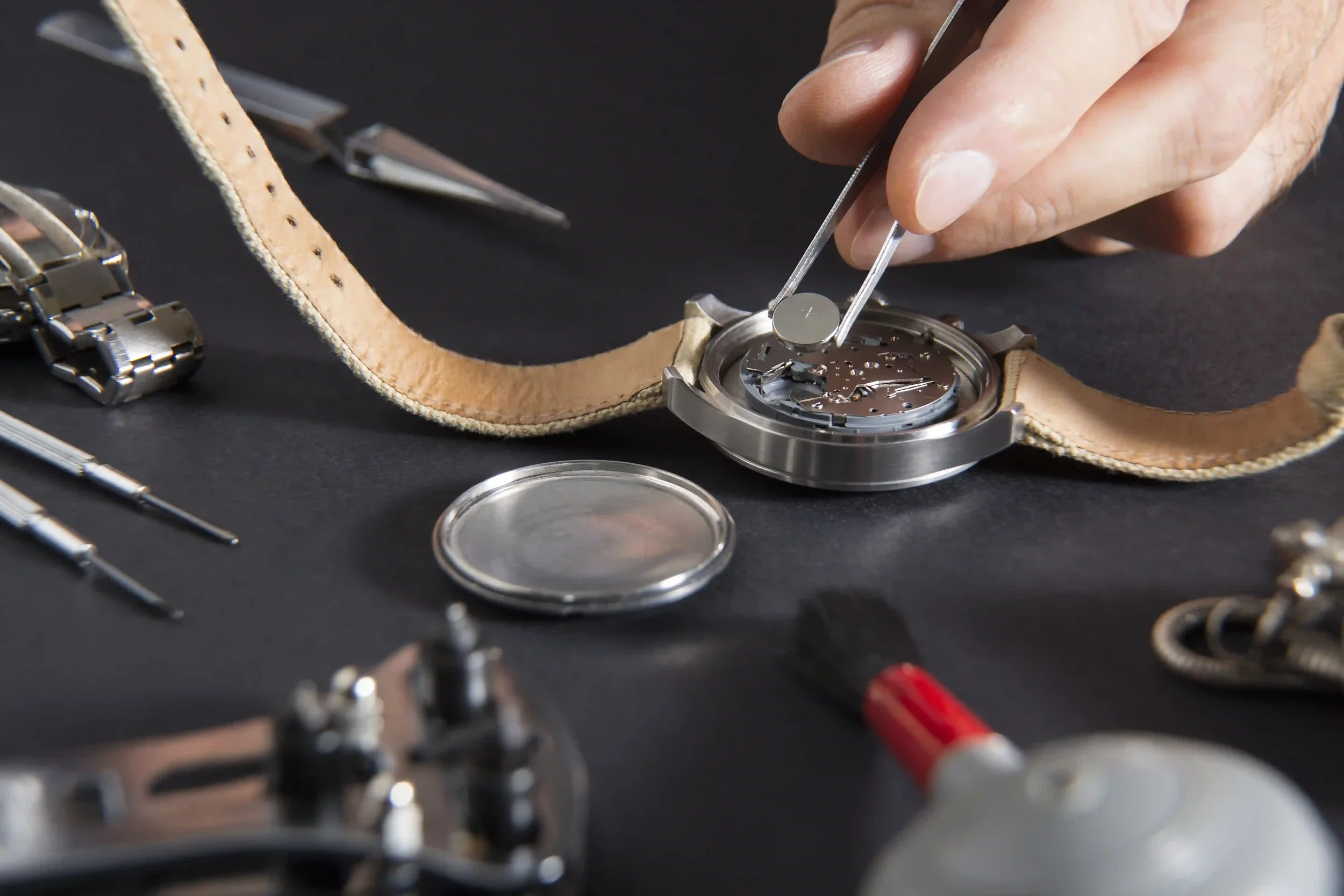
For an inexpensive everyday watch, a quick £5 high-street battery swap is often perfectly fine. However, for a timepiece you actually value, we regularly see rushed, low-cost battery changes cause catastrophic problems. Cutting corners to save a few pounds on the bench usually results in damage that costs hundreds to put right. Here are the most common risks:
Lost Water Resistance: Opening a watch case disrupts its rubber seals. If the shop skips the proper resealing and pressure testing, your watch is left completely unprotected from moisture.
Corrosive Battery Leaks: Budget kiosks frequently use cheap, generic alkaline cells. These are highly prone to leaking corrosive battery acid inside the case, which can completely destroy a delicate quartz movement.
Cosmetic and Mechanical Damage: Slipping with the wrong tools can leave deep, unfixable gouges on a stainless steel case back, mark the dial, or strip delicate case threads.
Missed Internal Faults: Sometimes a stopped watch isn't suffering from a dead battery—it might have a mechanical blockage or a faulty circuit. A quick kiosk swap often ignores these underlying issues, hiding the real problem until it's too late.
Spotted Moisture inside Your Lens? Take a look at our emergency guide on what to do if your watch gets wet to save your timepiece before the damage becomes permanent.
How Often Should You Replace a Watch Battery?
Most quartz watch batteries last between 1 and 5 years. For most owners, a battery change is a once-every-few-years investment rather than an annual expense.
The exact lifespan depends entirely on the movement and its features:
Time-Only Models: A simple two- or three-hand quartz watch sips power and can easily run for 4 to 5 years on a single cell.
Feature-Heavy Models: Chronographs (stopwatches), active backlights, and alarms draw significantly more power, often draining a battery in 18 months to 2 years.
The Golden Rule: Never leave a dead battery sitting inside your timepiece. A flat cell left unchanged for months can leak, and that corrosive leakage is one of the most common causes of avoidable movement damage we see on our bench. A timely replacement doesn’t just keep you on time—it protects your watch from a far more expensive repair bill down the line.
Watch Battery Replacement Near Me: High Street vs Specialist
A quick search for "watch battery replacement near me" will surface a mix of supermarkets, key-cutting kiosks, high-street jewellers, and independent watch repair shops.
If you have a basic, inexpensive fashion watch, any of them can handle it. But if you own a water-resistant, luxury, or sentimental timepiece, we always recommend using a specialist. The premium you pay at a dedicated workshop ensures you receive genuine parts, proper lubrication, and a mandatory pressure test to keep moisture out.
Want to spot the warning signs? Knowing the signs your watch battery needs replacing helps you act before a dying battery leaks, and our tips on how to look after your quartz watch help you get the most from each cell.
Do Luxury Watches Have Batteries? Rolex, Omega, and Cartier
It’s a common misconception that luxury timepieces never use batteries. Many prestigious brands rely on quartz movements.
We regularly service high-end quartz calibres on our Hatton Garden bench, including Cartier, Omega, TAG Heuer, and Breitling. These high-accuracy movements require model-specific silver-oxide cells, manufacturer-spec case-back and crown gaskets, and precise torque settings to maintain case integrity and preserve the watch’s residual value.
By contrast, nearly all modern Rolex timepieces house an automatic movement, powered by the natural kinetic motion of your wrist. In which case, if your Rolex has stopped ticking, it requires a mechanical watch service to clean, oil, and recalibrate the movement.
(Note: If you own a vintage Rolex from the 1970s to the early 2000s, it might be a rare Rolex Oysterquartz or a Reference 5100, in which case, yes, it does require a specialist battery change!)
Can You Replace a Watch Battery Yourself?
For a basic, inexpensive fashion watch with a "snap-off" back, a careful owner can technically change the battery at home with the right tools. However, the risks of a DIY workbench are very real.
Without professional training, it is incredibly easy to scratch the case steel, slip and bend a hand, install a leaking alkaline cell, or completely break the watch's water resistance without realising it. For any timepiece with a screw-down back, a certified depth rating, or high financial or sentimental value, we strongly recommend having it serviced by a professional watchmaker.
Battery Replacement at AMJ Watch Repair
At AMJ, we provide watch battery replacements for both everyday and luxury timepieces, starting from just £20. Our process is built entirely around protecting your watch, not just powering it:
While-You-Wait Service: Most swaps are completed securely on-site in just 15 to 45 minutes (though we always recommend calling ahead to check bench availability).
Resealing & Pressure Testing: Every water-resistant watch is fitted with new seals and undergoes a rigorous water-pressure test, complete with an official test report for your peace of mind.
Premium Swiss Cells: We exclusively use high-quality silver oxide batteries that are exactly matched to your manufacturer's reference specification.
Specialist Handling: Vintage heirlooms, high-end quartz calibres, and designer models receive anti-static precautions and delicate care.
No Hidden Costs: We provide a free, no-obligation fixed quote after a quick visual inspection, before any work begins.
Nationwide Postal Service: Can’t make it to Hatton Garden in person? Protect your timepiece with our secure, fully insured watch battery replacement service by post, available from anywhere in the UK.
Frequently Asked Questions
How much does a watch battery replacement cost in the UK?
The cost of replacing a watch battery in the UK is typically £10–£40 for a standard quartz watch, and £40–£150 or more for a luxury or water-resistant watch that requires new seals and a pressure test. We start from £20 and provide a fixed quote before we begin any work.
Where can I get a watch battery replaced near me?
You can have a watch battery replaced at supermarkets, jewellers, and specialist watch workshops. For a basic watch, a high-street option is fine; for a water-resistant or luxury watch, choose a specialist who reseals and pressure-tests the case. We offer a while-you-wait service from our workshop in Hatton Garden, London.
How long does a watch battery last?
Most quartz watch batteries last between one and five years. Watches with extra functions, such as chronographs, backlights, or alarms, use more power, so we usually replace their batteries more often than those of simple time-only watches.
Do Rolex watches have batteries?
The vast majority of Rolex watches are automatic mechanical watches and do not use a battery; they are powered by the motion of your wrist. Only a small number of older quartz Rolex models used a battery, so if yours is a Rolex, we'll confirm which type it is.
Does replacing the battery affect my watch's water resistance?
Yes. Opening the case back disturbs the seals that keep water out. To maintain water resistance, we service or replace the gaskets, reseal the case, and pressure-test the watch to its rating before we return it.
How long does a watch battery replacement take?
We complete most battery replacements while you wait, typically in 15–45 minutes. Water-resistant watches that need resealing and pressure testing may take us a little longer, so we recommend calling ahead.
Do you replace batteries in luxury watches?
Yes. We specialise in battery replacement for vintage, designer and high-end quartz watches, including quartz models from Cartier, Omega, TAG Heuer and Breitling, using specialist tools and anti-static handling.